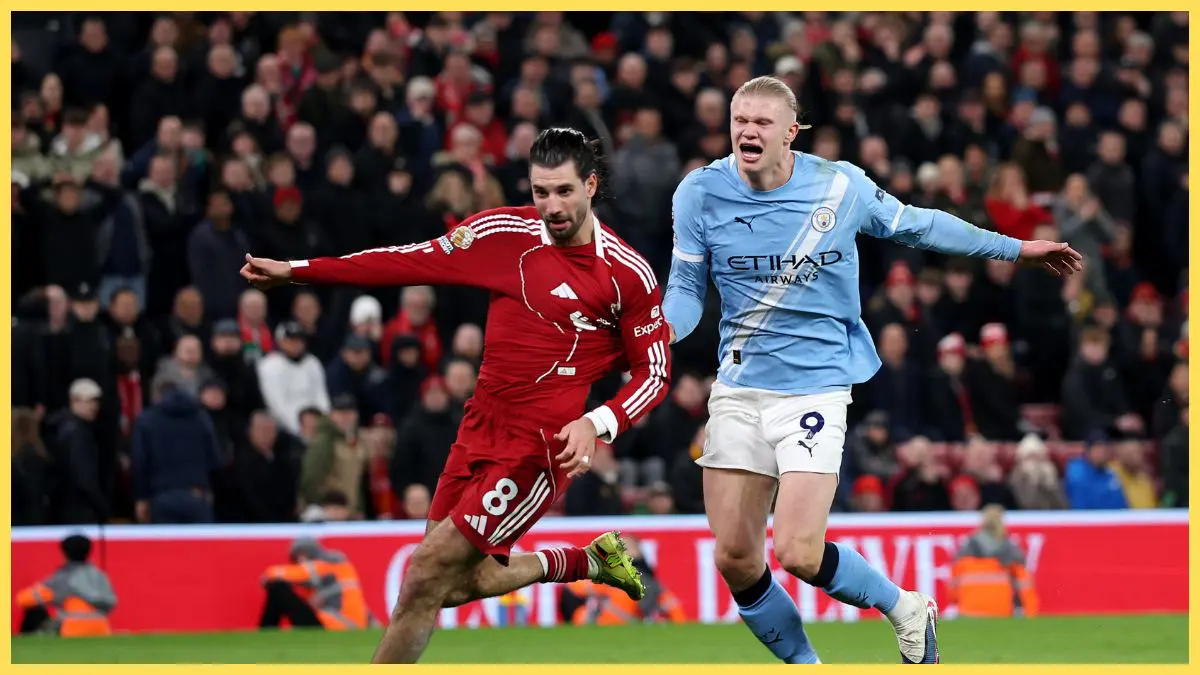
Liverpool’s dramatic late loss to Manchester City continues to fuel discussion, with former PGMOL chief executive Keith Hackett casting doubt over the decision to send off Dominik Szoboszlai at Anfield.
The Hungary midfielder was dismissed in stoppage time for allegedly denying Erling Haaland a clear goalscoring opportunity, even though the ball ended up in the net seconds later.
That call has already sidelined Szoboszlai for Wednesday night’s trip to Sunderland, but Hackett argues the laws may have been misapplied.
According to the ex-refereeing chief, the key question is whether referee Craig Pawson had played advantage before returning to punish the offence.
Speaking to Football Insider, Hackett said: “We need to revisit the law on advantage.
“If a referee applies advantage after a denial of an obvious goalscoring opportunity, the player should be booked, not sent off.”
Why the advantage law is central to Szoboszlai’s red card
Hackett’s stance is based on a rarely understood part of Law 12, which states that if advantage is played following a DOGSO offence and a goal is scored, the punishment should be downgraded to a yellow card.
In this case, Rayan Cherki’s long-range strike crossed the line before VAR stepped in, with Pawson eventually chalking off the goal and returning to the original foul.
For Hackett, that sequence is crucial.
“The issue is whether advantage was applied,” he added. “If it was, then the correct outcome is a yellow card, not a red.”
That view has only deepened frustration around an incident many Liverpool supporters already felt was severe, especially considering Szoboszlai’s overall performance.
The midfielder completed the full 90 minutes, scored a stunning free-kick, won 15 ground duels, made eight recoveries, and spearheaded Liverpool’s press in the second half as City were forced onto the back foot for long spells (via Sofascore).
Divided opinions over Szoboszlai decision
Hackett is not alone in questioning the decision.
Both Erling Haaland and Pep Guardiola expressed sympathy for Szoboszlai after the match, with Guardiola suggesting that common sense should have applied had the goal been allowed to stand.
Former referee Dermot Gallagher, however, took the opposite stance, arguing that once the goal was ruled out, VAR had no option but to revert to the initial offence.
Those contrasting views underline the ongoing confusion over how advantage and VAR should operate together in high-stakes moments.
For Liverpool, the fallout is now more than theoretical.
Szoboszlai’s suspension leaves Arne Slot short-handed ahead of a challenging midweek trip to Sunderland, with momentum once again checked by a refereeing call that will be debated long after the final whistle.
Regardless of whether Hackett’s interpretation ultimately gains wider acceptance, one thing is clear: the Szoboszlai red card was far from a simple decision, and Liverpool may feel the punishment was harsher than the laws truly required.